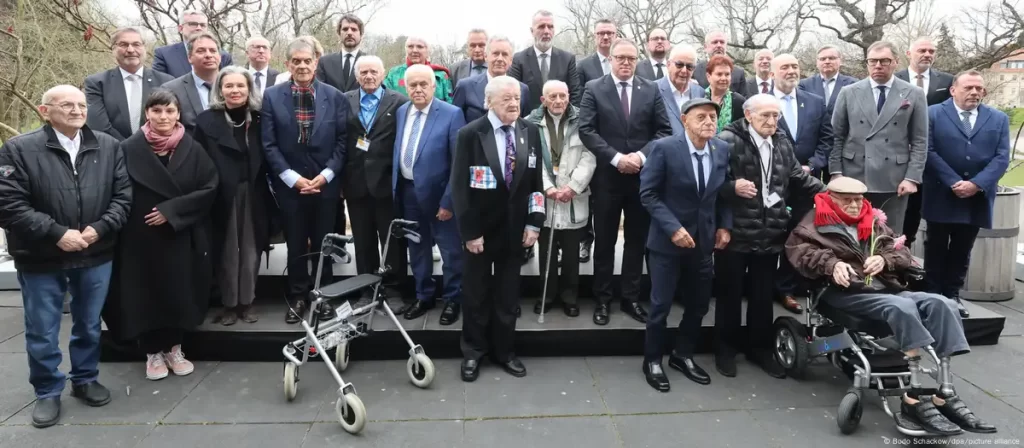
On April 6, 2025, a ceremony was held at the memorial complex on the site of the former Nazi concentration camp Buchenwald in Germany, marking the 80th anniversary of its liberation. It took place in the presence of officials from many European countries. Ten former prisoners of this concentration camp from Germany, Belarus, France, Israel, Romania and Switzerland also participated in the commemorative events. They laid wreaths in memory of the tens of thousands of people killed at Buchenwald during the Second World War.
The Prime Minister of the federal state of Thuringia, Mario Voigt, addressed the ceremony, stating that we now live in a time “when antisemitism, nationalist ideology and authoritarian thinking are becoming louder and more widespread.” Former German President Christian Wulff also spoke, drawing parallels between the era of National Socialism and the rise of right-wing forces today. “Because of the brutalisation, radicalisation and shift to the right around the world, I can now more clearly imagine — and this worries me — how it could have happened back then,” said Wulff. He called for the active defence of the values of democracy and humanism. “We bear a permanent, continuous, eternal responsibility, because evil must never triumph again,” the former German president declared.
Buchenwald was one of the largest concentration camps in Nazi Germany, located in Thuringia near Weimar. The camp operated from July 1937 to April 1945. During this time, according to various estimates, between 250,000 and 280,000 people were imprisoned there. Officially, Buchenwald did not have the status of a “death camp”, yet from the very beginning of its operation in 1937, the systematic extermination of people was carried out there. At least 56,000 people were killed. A significant proportion of prisoners died from starvation and as a result of inhumane experiments conducted on them.
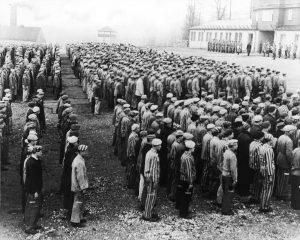
Initially, the composition of Buchenwald’s prisoners was heterogeneous. Among the first waves of prisoners were political prisoners, Jehovah’s Witnesses, criminal offenders, and homosexual men. In February 1938, a torture chamber and execution room were created. From May of that year, the camp administration designated Jews as a separate category among the prisoners. Throughout 1939, waves of typhus and dysentery epidemics swept through Buchenwald, claiming the lives of thousands of prisoners. In 1940, a crematorium began operating in the camp and the extermination of people took on a systematic character. With the outbreak of Germany’s military campaign against the USSR in 1941, Soviet prisoners of war became a numerous category of inmates. To the west of the camp, in the SS stables, a special execution device was installed. According to approximate estimates, around 8,000 Soviet prisoners of war were shot at Buchenwald.
From 1942 onwards, mass medical experiments on prisoners were conducted in the camp. More than half of the human subjects died in agonising circumstances. Prisoners were infected with typhus, tuberculosis and other dangerous diseases in order to test the effectiveness of vaccines against the causative agents of these illnesses. Camp documentation on hormonal experiments conducted on homosexual prisoners has been preserved.
It is a notorious fact that in 1944, the Chairman of the Communist Party of Germany, Ernst Thälmann, was shot in the crematorium building of the camp.
Buchenwald’s prisoners were ruthlessly exploited in many large industrial enterprises, including armaments factories located in the vicinity of the camp. The labour of prisoners was used at the factories of Krupp, Flick, Thyssen, Siemens, Daimler-Benz, I.G. Farben and others. On August 24, 1944, the allies of the anti-Hitler coalition bombed the armaments enterprises and SS barracks in the surroundings of Buchenwald. Particularly many prisoners perished during the bombings at Buchenwald’s satellite camp Dora-Mittelbau, where the “vengeance weapons” V-1 and V-2 were manufactured in underground workshops.
As the Eastern Front approached Germany’s borders, prisoners from other regions began arriving at Buchenwald — in autumn 1944 from concentration camps in Latvia, and in January 1945 thousands of Jews were forcibly brought from Polish concentration camps. Many of them were gravely ill, and hundreds of bodies remained lifeless in the railway wagons. In February 1945, Buchenwald became the largest death camp, holding over 112,000 prisoners.
An underground resistance movement operated at Buchenwald camp, led by the International and Military Committees. A total of 188 combat groups were formed. The underground fighters collected and manufactured weapons.
On April 8, 1945, through a radio transmitter concealed in the bottom of a rubbish bin, the underground fighters transmitted a call for help to the advancing Allied troops.
On April 11, an armed uprising began at Buchenwald. The prisoners disarmed and captured over a hundred SS officers and guards. The camp came under the management of the underground committee composed of prisoners of various nationalities, the captured weapons were distributed, units were formed and defensive positions were taken. A few hours later, American reconnaissance groups and other units of the US Third Army arrived at the liberated camp. Since then, April 11 has been commemorated as the International Day of Liberation of Nazi Concentration Camp Prisoners. On April 13, 1945, the entire Buchenwald area was occupied by American forces.
In 1958, the decision was made to open a national memorial complex at Buchenwald. Today, only the cobblestone foundations remain of the barracks. Near each one stands a memorial inscription. The Buchenwald memorial complex preserves the crematorium building, watchtowers and multiple rows of barbed wire, and the camp gates with the inscription “Jedem das Seine” (German: “To each what he deserves”) remain untouched.